
Do Cruise Ships Still Use a Steering Wheel?
While you might envision cruise ship captains standing on the bridge, steering ships in and out of port via a massive wheel, the reality is a lot less dramatic, but definitely more technologically interesting.
That’s right. Modern ships, cruise or otherwise, do not use steering wheels in the traditional sense. Instead, they use highly technical, innovative processes that make it possible to steer these massive vessels with just a few simple moves.
Here’s everything you need to know about cruise ship steering.
In this Article:
The Basics of Cruise Ship SteeringWhat is a Ship’s Steering Wheel Called?Who Drives a Cruise Ship?Why Do We Think Cruise Ships Use Steering Wheels?The History of Cruise Ship SteeringHow Are Cruise Ships Steered Today?Cruise Ship Steering Today vs. The Old Wooden Steering Wheel
The Basics of Cruise Ship Steering
While the technology may be different, the basics of cruise ship steering are broadly the same as they’ve been for centuries.
The ship has its rudder, which is typically a large, vertical, flat metal blade at the back of the ship. It sits behind the propellers. When the rudder moves, it changes the flow of water coming off the propellers and, thus, the ship moves.
From old fashioned ship steering wheels to today’s tech heavy systems, the rudder is still the key component that changes the ship’s direction.
What is a Ship’s Steering Wheel Called?
A ship’s steering wheel is called a helm and, even though typical steering wheels are not used on larger ships today, the steering and control station on a ship can still be referred to broadly as “the helm,” (for example, you might hear statements such as “the captain is at the helm”).
Who Drives a Cruise Ship?
While the captain is the head of the cruise ship, others who may be involved in driving the ship include navigators, with titles including the helmsman, quartermaster lookouts, Officers of the Watch, assistant Officers of the Watch, cruise ship pilots and navigation cadets.
Why Do We Think Cruise Ships Use Steering Wheels?
I’ve been on multiple cruise ship bridges over the years, and these behind-the-scenes glimpses into a cruise ship’s operations are always a treat.
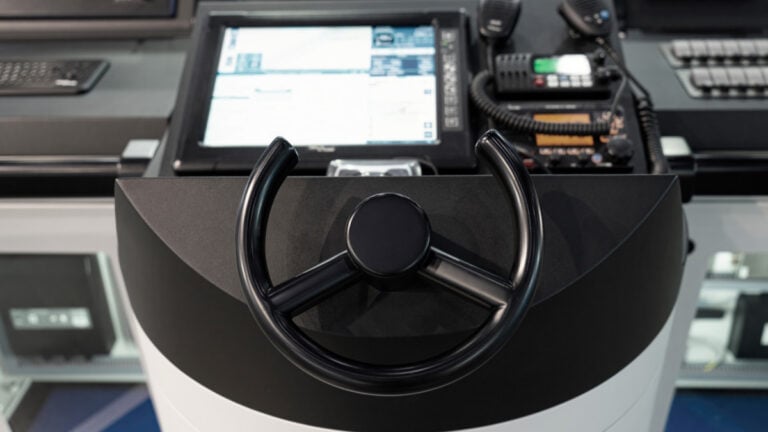
However, if you’re visiting the bridge hoping to see a giant wheel (as so many newbie cruisers often do), you’re going to be sorely disappointed. You may see a tiny (smaller than a car’s steering wheel) wheel mechanism, but it probably won’t even be in use. It’s reserved for emergency situations only.
So why do we always think of cruise ships, or any large ship for that matter, as using gigantic steering wheels to get around?
Maybe it’s because we’re accustomed to that kind of imagery thanks to pop culture and movies set in the era of pirates and privateers. Maybe it’s because we think that’s how ships have always been steered.
You might be surprised to know, though, that that’s not really the case at all. Ships have been steered several different ways over the long history of sea travel.
The History of Cruise Ship Steering
As detailed in a fascinating article from the U.S. Naval Institute magazine, the ship’s wheel was only introduced in the 18th century. Prior to that, other steering mechanisms were used.
These devices included the steering oar, rudders and tillers, ropes and pulley systems, and whip staffs, among others. While they worked for the time, though, they weren’t ideal as ships became bigger and more agility was necessary during naval battles or similar tight spots.
As such, with a bit of engineering ingenuity, the British Royal Navy began developing the earliest version of a ship wheel. It caught on quickly due to its clear superiority, and soon it became the go-to, all around the world.
Of course, the same evolution that brought on the invention of the ship wheel also led to its demise. Ships continued to become bigger and bigger and bigger, and the wheel just wasn’t a feasible option for the typical sea-going vessel.
Today, your best bet for seeing such a ship’s wheel is to visit a naval history museum or similar, to check out some historic ships, because you’re not going to find one on modern vessels.
How Are Cruise Ships Steered Today?
So if ships do not use wheels today, how exactly are they steered?
There’s a really great and short video from Princess Cruises that breaks it down, but I’ll break it down here for you, too.
As the Captain explains and shows, there is a very small wheel on the bridge, but it’s not often used, just in particularly difficult ports. Otherwise, they utilize a track control system, electronic controls, and a joystick to keep the ship “on track.”
Much like on an airplane, the ship can do a lot of the process on its own, with navigators monitoring and ensuring the ship’s progress on computer screens, just to ensure that everything is running smoothly.
If you want another look at the process, and a bit more of a deep dive into the physics of it all, Simple Things Simplified likewise published a good video showing off the mechanisms on Royal Caribbean’s Wonder of the Seas.
In this video, we likewise see an officer using a joystick to guide the ship as needed, but then the narrator goes into just how steering a ship of this magnitude is possible with such a seemingly tiny bit of technology, detailing what’s called an azimuth thruster, and the physics necessary for moving a cruise ship.
Cruise Ship Steering Today vs. The Old Wooden Steering Wheel
Cruise Ship Steering TodayThe Old Wooden Steering Wheel Method How it WorksAn electronic system uses a joystick, track control system, GPS, radar, and similar devices to steer the ship with minimal human help needed.The wheel connected to the rudder through the ship’s decks and manual, physical force was always necessary for the ship to move.Effort RequiredWhile extensive training and expertise are required, the actual steering requires little to no effort on the part of the captain or navigator.Quite a lot of strength was necessary to move these old steering wheels, sometimes even requiring multiple crew members, in heavy weather. PrecisionAn electronic system uses a joystick, track control system, GPS, radar, and similar to steer the ship with minimal human help needed.The navigation was all on the captain and navigators, and a precise course was less guaranteed.Response TimeThe joystick and electronic system responds almost immediately to manual changes.Due to all the mechanical engineering across decks, there could be some wait time between the turning of the wheel and the actual movement of the rudder.Crew Members NeededThe system can be monitored by only one crew member (though many more are on the broader navigation team).Several individuals would be needed to move the wheel in certain conditions.Safety and EffectivenessThese systems are very safe and effective, with few errors and, even if an error or failure was to occur, backups exist, even those small wheels that can be used if absolutely necessary.No backups were immediately available, adding to the riskiness of ship travel during historic time periods.LocationSteering is done from an enclosed bridge.The steering wheel would typically be situated out on the open deck, giving the captain a clear line of sight.