
Cruise Ship Lifeboats: Are There Enough and What You Might Not Know
Modern cruise ships are equipped with numerous pieces of safety equipment, including lifeboats and inflatable life rafts. While SOLAS and other safety regulations strictly control lifeboat capacities, the actual number of lifeboats on a cruise ship will not match the total number of passengers and crew members.
This guide will explain why lifeboats aren’t required for every person and what the lifeboats themselves are like.
In This Article:
Why Cruise Ships Don’t Need Lifeboats for EveryoneHow Many Lifeboats Are on a Cruise Ship?What Do Cruise Ship Lifeboats Look Like?What’s Inside a Lifeboat?How Safe Are They Really?Conclusion
Why Cruise Ships Don’t Need Lifeboats for Everyone
It’s a common misconception that cruise ships must have enough lifeboats for every person onboard.
In reality, international regulations, specifically the International Convention for the Safety of Life at Sea, or SOLAS, mandate that all cruise ships carry lifeboats for at least 37.5% of the maximum number of passengers on each side of the vessel, which equals 75% of the total number of people on the ship (passengers and crew included) when factoring in both sides.
The remaining 25% of the ship’s capacity is then met with inflatable life rafts, ensuring total coverage for all aboard. Most cruise ships reserve these inflatable life rafts for the crew, as they are more difficult to board, as well as less comfortable.
By carrying only enough hard-surface lifeboats for 75% of the ship’s maximum capacity, cruise ships can make more efficient use of space. This is simply because lifeboats take up a substantial amount of deck space, while inflatable life rafts can be stored in a far more compact and discreet way.
How Do Lifeboats and Inflatable Life Rafts Differ?
Both lifeboats and inflatable life rafts serve the same basic function, but lifeboats are more sophisticated. Where life rafts are inflatable and usually just powered with telescopic oars contained within them, lifeboats are made from rigid materials, like carbon fiber, and they are often motorized.
Lifeboats also need to be lowered from the sides of the cruise ship carrying them, while life rafts are usually stored in pressurized heavy-duty canisters that are automatically inflated and ejected from the sides of the ship when required.
Given that inflatable cruise ship life rafts are deployed quickly rather than slowly lowered with passengers inside, cruise ships are almost always outfitted with a complex marine evacuation system.
This system includes additional inflatable spiral slides or chutes that can be rapidly deployed to allow guests and crew to travel safely down to inflated life rafts in the water below.
How Many Lifeboats Are on a Cruise Ship?
Since lifeboat regulations dictate that cruise ships only have to carry enough lifeboats to carry at least 75% of the ship’s passenger and crew capacity, the exact number of lifeboats on a cruise ship will vary drastically depending on the ship’s size and design.
Most large cruise ships will carry between 15 and 20 lifeboats in total, with that number evenly split between the ship’s sides. Again, these numbers will vary, as will the actual size and capacity of the lifeboats themselves.
For example, Royal Caribbean’s Oasis of the Seas is equipped with 18 CRV55 catamaran lifeboats, each capable of carrying up to 370 people on two levels.
When first introduced, these were the largest lifeboats in the world, weighing roughly 97,000 pounds each when fully loaded with equipment and passengers.
For comparison, a smaller cruise ship, like Carnival Elation, is only equipped with 14 lifeboats, each with a capacity of roughly 150 people. It may sound strange, but one of the largest cruise ships ever built, Royal Caribbean’s Icon of the Seas, only carries 17 lifeboats, but each can safely carry up to 450 people.
In addition to carrying lifeboats that at least meet the legal minimum passenger capacity, cruise lines also conduct regular lifeboat drills and monthly lifeboat inspections to ensure that all safety equipment can be deployed efficiently and is maintained properly.
What Do Cruise Ship Lifeboats Look Like?
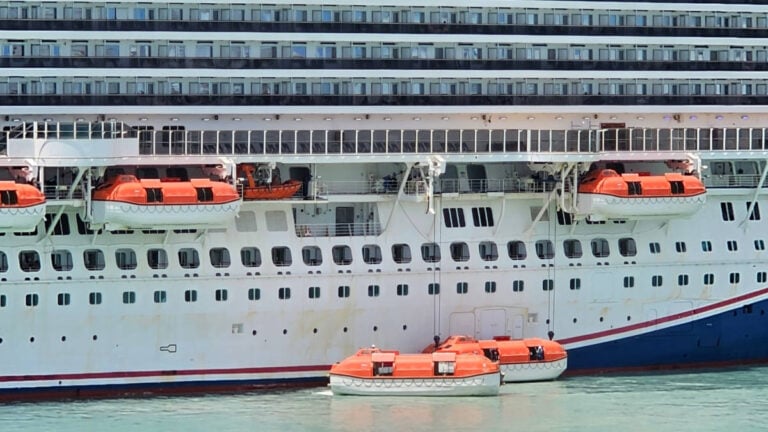
Modern lifeboats are a far cry from the basic rowboats you have probably seen in movies like James Cameron’s Titanic. Instead, they are fully enclosed vessels constructed from durable materials, like fiberglass.
Most are yellow watercraft with white highlights, which helps them be spotted against a blue backdrop if they are ever deployed. Some are also orange, but yellow and white is definitely the more popular color scheme.
As mentioned, they are motorized, with larger models equipped with powerful twin diesel engines that can propel the lifeboats to speeds as high as 6 knots. The lifeboats also feature windows, safety hatches, illuminated compasses, and searchlights, which help with navigation and visibility.
What Do They Look Like on the Inside?
Inside these lifeboats, you’ll find numerous rows of seating, which allow the small ships to maximize capacity. Larger lifeboats, like those found on Icon of the Seas, will even have two decks, allowing them to make even greater use of their size.
Since they are motorized, they also feature a steering area, which is located at the front of the lifeboat.
This area is occupied by trained members of the cruise ship’s crew, so the ship’s passengers simply have to sit in the main passenger area of the lifeboat when it is deployed. This is also where the lifeboat’s communication and navigation equipment can be found.
Some lifeboats also double as tender boats, ferrying passengers to shore during port of call visits. This allows the cruise ship to maximize deck space, as the lifeboats serve a dual purpose.
From my experience, lifeboat tenders offer a bit of a rougher ride, so you might want to bring some sort of motion sickness medication if you are sensitive to it.
With that said, they are fully enclosed, so you don’t have to worry about getting splashed, which is definitely a nice thing if you’re visiting a port on a cold or windy day!
What’s Inside a Lifeboat?
While the exact equipment a lifeboat carries will vary, depending on the size of the lifeboat and the cruise line that has outfitted it, most modern lifeboats are very well-equipped. Inside, you’ll find essential survival equipment for all passengers and crew members traveling inside it.
If the lifeboat was deployed during an evacuation procedure, it would contain the survival equipment the occupants would need until they were rescued by a larger vessel.
Again, the exact contents inside a lifeboat will vary, but most contain the following:
Enough life jackets for every person
Six 500ml water packets for each passenger
Food rations (usually high-calorie biscuits or bars stored in multi-pack boxes)
Fishing tackle and fishing line
Flashlights with an extra battery
First-aid kits (first aid supplies include seasickness tablets and seasickness bags)
Smoke signals, hand flares, and whistles
Oars and anchors in case the engines fail
Toilet facilities that consist of disposable bags and composting toilets
Thermal protective blankets and microfiber towels
Fire extinguishers
Extra equipment (a can opener, saw, rope, rolled-up rope ladder, illuminated compass)
For the most part, these supplies are stored beneath the passengers’ feet in the main area of the lifeboat. To access all of these supplies and pieces of safety equipment, the passengers would have to move around and lift large floorboards, so this is only done in real survival and evacuation scenarios rather than during basic drills.
How Safe Are They Really?
The sinking of the Titanic triggered a complete overhaul of lifeboat and life raft requirements on passenger ships. In response to this tragedy and the fact that the famous ocean liner wasn’t carrying enough lifeboats, the International Maritime Organization established SOLAS in 1914, setting stringent safety regulations for all types of seafaring passenger vessels.
These safety requirements have been continuously enhanced and improved over the more than 100 years that have followed.
Even more modern incidents, like the Costa Concordia disaster in 2012, have led to improved safety standards, with all cruise lines now having to work with certified lifeboat technicians to ensure all maintenance and inspections are carried out by trained professionals.
Today, all cruise ships must undergo monthly inspections of their lifeboats and life rafts, not only to ensure they have a combined passenger capacity to carry every single person on the cruise ship, but also that they are well-maintained and safe to use.
Load tests using water weights are also conducted to simulate the full weight of passengers and ensure the lifeboats are buoyant and free from cracks, hatch leaks, and more.
Mandatory lifeboat drills must also be conducted to ensure the crew’s readiness during emergencies. Muster drills are also used to make it clear to passengers where to go in an emergency.
The actual design of the lifeboats has also been revolutionized, with bright color schemes ensuring they can be spotted by a rescue vessel and flame-retardant materials reducing the risk of fires.
They are also made from extremely durable materials that can withstand long-term exposure to rough seas. On top of all that, the lifeboats also carry essential supplies, including adequate fresh water pouches and food rations for all occupants.
Conclusion
Embarking on a cruise is one of my favorite things in the world. While it may not be the most exciting part of the trip, it is encouraging to know that the cruise lines and their highly trained crews have all the safety measures and equipment in place to ensure my trip will be perfectly safe, even in the extremely unlikely scenario where I need to board a lifeboat.
With state-of-the-art lifeboats capable of carrying at least 75% of the cruise ship’s maximum capacity, and quick-deploy life rafts able to carry any remaining passengers and crew, you can rest assured that your cruise vacation will be as safe as it is enjoyable!
Cruise Ship Lifeboats: Are There Enough and What You Might Not Know