
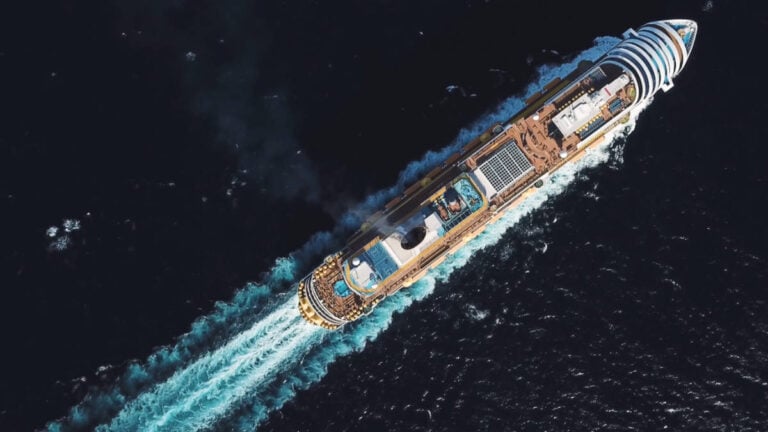
How Fast Do Cruise Ships Go? Speed Facts & What Affects It
Even though cruise ships are not designed for speed, they can still move reasonably fast for their size. The average cruise ship speed typically sits between 18 and 20 knots, with some smaller ships traveling faster.
These averages translate to roughly 21 to 23 miles per hour (mph) on land. As for the top speed of a cruise ship, some can get up to 30 knots, or roughly 34.5 mph, under ideal conditions.
In This Article:
How Speed Is Measured for a Cruise Ship (Up to 22 knots!)Why Cruise Ships Don’t Travel at Full SpeedDistance Per Day: How Far Cruise Ships TravelFastest Cruise Ships on RecordWhat Factors Affect a Cruise Ship’s Speed?See You on the Fastest Ship!
How Speed Is Measured for a Cruise Ship (Up to 22 knots!)
You may wonder why I listed average and top speeds for cruise ships in knots, but it’s a term used to measure nautical speed.
A knot is equivalent to one nautical mile per hour, which differs from a mile per hour on land, as they consider the Earth’s latitude and longitude. Accounting for the Earth’s circumference is more relevant for sea and air travel.
I’ll spare you the science behind the term and its historical background, but the main takeaway is that a nautical mile, or knot, equals roughly 1.15078 land miles, or 1.852 kilometers.
I know it sounds a little strange, but if you’re talking about a cruise ship traveling at 20 knots, it would be moving at roughly 23 mph from the perspective of someone standing on land.
If you’re still confused, here’s a quick conversion chart you can use to understand the speeds the average cruise ship travels:
18 knots = 20.7 mph or 33.3 km/h
19 knots = 21.8 mph or 35.1 km/h
20 knots = 23 mph or 37 km/h
If you’re ever trying to convert knots into miles per hour, you can just multiply the knots by 1.15078. It won’t be a perfect conversion, but you’ll be close enough!
Why Cruise Ships Don’t Travel at Full Speed
If most cruise ships can travel over 20 knots, why do they have a slower average speed? Well, they travel at slower speeds for a variety of reasons:
Fuel Efficiency and Operating Costs
Just like when you’re driving your car, traveling at higher speeds increases fuel consumption. Not only would faster cruises mean vessels would have to set sail with more fuel, but doing so would increase operating costs for the cruise lines.
In other words, operating faster cruise ships would mean the cruise lines would have to increase fare prices, or reduce profits, which just isn’t going to happen.
To give you an idea of how impactful increased speeds would be on fuel consumption, a cruise ship running at 25 knots burns nearly 50% more fuel than an identical one operating at 20 knots.
Reducing costs by keeping the average cruising speed and fuel consumption down also has the added bonus of reducing carbon emissions. With the cruise industry under more pressure than ever to reduce its environmental impact, keeping speeds lower just makes sense from all angles.
Passenger Comfort
Another reason cruise ships rarely travel at their top speed is that faster speeds usually translate to more noticeable movements, especially if the vessel is traveling in choppy waters.
After safety, cruise lines prioritize passenger comfort above pretty much everything else. By traveling at consistent and slower speeds, passengers experience a smoother ride. There’s also the simple fact that cruising is all about enjoying the journey.
Unlike ferries and some ocean liners, where getting to the destination as quickly as possible is the primary objective, a cruise is all about enjoying the journey and onboard experience, so there isn’t the same incentive to hit the gas.
Cruise ships also have to consider certain onboard activities and venues, like live shows, numerous restaurants, and even full-size swimming pools. Keeping the speed down helps minimize disruptions that could be an issue if the ship was cutting through the water at top speed.
That said, cruise ships sometimes increase their speed if a medical emergency occurs on the ship or they are behind schedule due to unforeseen delays, like severe weather.
Port Timing and Itinerary Considerations
All cruise ships also have to adhere to set arrival times at the various ports they visit to coordinate with shore excursion providers and the port’s scheduling. Traveling at a predictable and moderate speed makes it much easier to stick to a set arrivals and departures schedule.
Since almost every vessel will travel at a similar speed, it is much easier to coordinate itineraries with other cruise ships than if ships were all traveling at various top speeds.
Again, a big part of taking any cruise is enjoying the trip, so cruise ship operators want to ensure that the ship’s speed is comfortable for passengers and that the ship arrives at ports exactly when it should.
Distance Per Day: How Far Cruise Ships Travel
Given that cruise ships tend to travel at roughly 20 knots, they can cover about 400 to 500 nautical miles in 24 hours.
Assuming that the average cruise ship travels at about 19 knots, or roughly 21 miles per hour, it would cover 504 miles in 24 hours.
However, it’s important to remember that the vessels also slow down at points due to sea conditions or because their itinerary includes port-of-call visits, which is why the average tends to sit between 400 and 500 miles.
Naturally, when they approach a port, they significantly reduce their speed to comply with port regulations.
Typical Distances Covered
To give you an idea of how far a cruise ship will travel in a day, here are a few examples of average distances covered in various regions.
A Caribbean cruise from Miami to Nassau in the Bahamas would cover roughly 185 nautical miles, easily achievable at standard speeds in a day. Since these cruise itineraries usually involve island hopping, the distance covered per day is much lower than that of traveling much greater distances.
If you’re talking about a typical Alaska cruise, distances covered daily can be even shorter. This is because the main ports are relatively close to each other.
In fact, the entire Alaska portion of an Inside Passage voyage only measures around 500 miles, so ships tend to travel at a more leisurely pace. Plus, the entire purpose of an Alaska cruise is to take in the scenery, so it only makes sense to travel shorter distances per day at a slower pace.
Now, if you’re talking about transatlantic voyages, like a voyage from New York to Southampton in England, the journey would span about 3,150 nautical miles, which most cruise ships will try to cover in 7 days. To meet that schedule, they must cover roughly 450 nautical miles daily.
Fastest Cruise Ships on Record
Although almost every type of cruise ship prioritizes passenger comfort over speed, some were designed to cover huge distances at a faster speed than the average vessel.
While she is an ocean liner rather than a cruise ship, SS United States traveled at speeds of over 38 knots, or roughly 44 mph. This pace was achieved during her maiden voyage in 1952, making her the fastest ocean liner.
Cunard’s Queen Mary 2 is the current fastest ocean liner, achieving a maximum speed of 30 knots, roughly 35 mph. While these speeds are definitely impressive, it’s important to remember that both ships are actually classed as ocean liners, so they’re not technically the resort-style cruise ships most people think of when they book a cruise.
This is simply because the two types of passenger vessels are designed for different purposes. Ocean liners cover massive distances to transport passengers from one side of the ocean to the other, while cruise ships meander from port to port, providing guests with a more relaxed vacation-style experience.
If you’re strictly discussing cruise ships, most of the larger ones, like Royal Caribbean’s Harmony of the Seas, have a top speed between 22 and 24 knots. Again, most rarely hit their top speed, but thanks to their powerful propulsion systems, they can exceed their usual 18 to 20-knot speeds.
What Factors Affect a Cruise Ship’s Speed?
Since there is some variation between the speeds cruise ships travel, you might wonder what factors impact this. Here’s a quick overview:
The Size of the Ship and Engine Type
Larger cruise ships require more powerful engines, which means they can achieve higher top speeds. On the other hand, more modern vessels are also designed to conserve fuel and reduce emissions, so they typically prioritize fuel economy, which means running at slower and more consistent speeds.
Weather and Sea Conditions
As you probably guessed, the weather and sea conditions can slow a cruise ship down. Rough conditions or choppy waters usually mean cruise ships move at slower speeds, both for the safety and comfort of the ship’s passengers.
In some cases, avoiding severe weather conditions can mean it will travel at faster speeds.
Itinerary Planning
Since cruise itineraries are carefully planned ahead of time to ensure timely arrivals at various ports, adjusting the ship’s speed can help a cruise ship maintain its schedule.
Environmental Conditions and Speed Limits
Certain areas also have speed limits enforced, both for the ships’ safety and the environment’s protection. This tends to be more of a factor when cruise ships travel near coastlines, which could be designated as protected marine environments.
See You on the Fastest Ship!
Even though cruise ships are usually capable of traveling at faster speeds, a number of factors mean they usually maintain a slower average speed.
Just like every aspect of the cruise industry, a cruise ship’s speed is carefully planned ahead of time. From maximizing passenger comfort to minimizing fuel consumption, the cruise industry balances these complexities perfectly.