
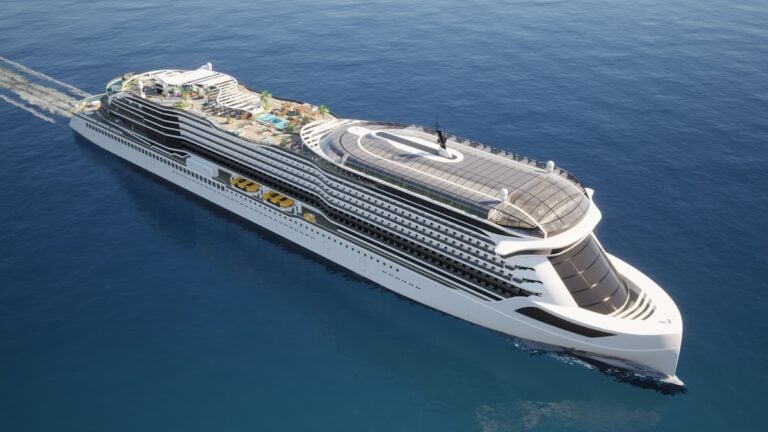
Shipyard Reveals Concept for Fully Battery-Electric Cruise Ship
Key Aspects:
Meyer Werft unveiled the project “Vision,” a concept for a fully battery-electric ship.
The 82,000-gross-ton ship could carry 1,856 passengers and be delivered by 2031.
The design could reduce greenhouse gas emissions by up to 95 percent.
The idea of a cruise ship powered entirely by batteries is moving closer to reality. German shipbuilder Meyer Werft revealed a concept for a fully battery-electric cruise ship this week during Seatrade Cruise Global in Miami.
The proposed vessel, called project “Vision,” would measure about 902 feet long and carry 1,856 passengers with a gross tonnage of approximately 82,000.
According to the shipyard, the design could cut greenhouse gas emissions by up to 95 percent with conventional cruise ships powered by marine fuels.
Unlike today’s cruise ships, which rely on large engines burning fuel such as liquified natural gas (LNG) or marine diesel, the concept ship would operate using a massive battery system supplied by Norwegian marine battery manufacturer Corvus Energy.
The project is intended as a concept study demonstrating how existing technology could support large passenger ships operating without traditional engines on certain routes.
“We asked ourselves how we can use innovation to reduce CO2 and contribute to decarbonization – not in 50 years, but much sooner,” said Tim Krug of Meyer Werft’s Concept Development Group. “We enable a reduction in greenhouse gas emissions of up to 95 percent.”
The shipyard, based in Papenburg, Germany, said the technology needed to power such a vessel already exists and could be implemented within the next decade if a cruise line placed an order.
“If ordered this year, we could already deliver the first ship in 2031,” said Thomas Weigend, chief sales officer at Meyer Werft.
The proposal comes as cruise lines face increasing pressure to reduce emissions and comply with tightening environmental regulations in major cruise markets, particularly across Europe.
Europe has already begun enforcing strict emissions regulations throughout the EU. Under the “Fit for 55” climate package, the EU aims to reduce gas emissions by at least 55 percent by 2030 compared with 1990 levels.
The plan aims for climate neutrality by 2050, with new rules already requiring ships to reduce fuel emissions and pay for carbon output when sailing to EU ports.
The regulation requires passenger ships to connect to shore power at major European ports beginning in 2030.
Industry leaders have been experimenting with new propulsion technologies in recent years, including hybrid ships, shore power connections in ports, and alternative fuels such as LNG and methanol.
Design and Technology
Project “Vision” is designed primarily for shorter regional itineraries where ships can recharge between ports.
According to Meyer Werft, a large portion of typical European cruise routes could be completed using battery power alone. One example cited by the shipyard is a sailing between Barcelona and Civitavecchia near Rome.
The feasibility of such routes depends heavily on shoreside charging infrastructure. The company said roughly 100 ports across Europe are expected to have charging capabilities in place by 2030, to meet “Fit for 55” regulations.
For longer voyages, the concept could also be configured as a hybrid vessel. In that scenario, smaller generators would supplement the battery system, allowing ships to complete routes such as transatlantic crossings while still reducing emissions significantly.
The ship’s architecture would also differ from traditional cruise ship layouts.
Because the vessel would not rely on large combustion engines, the design eliminates the need for a conventional exhaust funnel and vertical exhaust treatment systems that normally run through the ship’s interior.
Removing those structures would free additional space on the top decks, allowing for a redesigned sun deck with open views.
The concept also incorporates weather-protected spaces intended to make the ship usable year-round. One example is an indoor aqua park positioned at the stern of the ship, housed in a fully enclosed glass structure.
This design would allow the attraction to operate in cooler or rainy climates, particularly on northern European itineraries.
Without the traditional propulsion systems found on most cruise ships, Meyer Werft says the vessel would also generate significantly less vibration and mechanical noise throughout guest areas.
Meyer Werft said the project remains a study concept and now joins Norway’s Hurtigruten in its efforts to create a zero-emission ship.
Shipyard Reveals Concept for Fully Battery-Electric Cruise Ship