
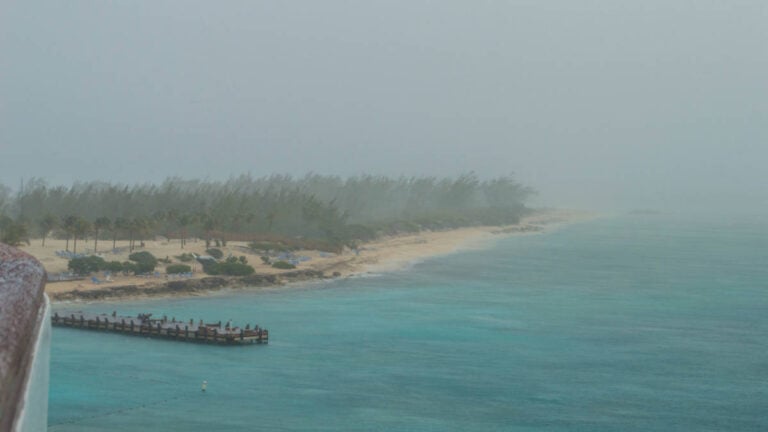
Cruising During Hurricane Season: What You Must Know!
Hurricanes can be devastating, catastrophic storms, not just for people living in coastal areas, but also for hotels, resorts, theme parks, and yes, cruise ships. I’ve been on over 40 cruises, including ones impacted by hurricanes, and I live in Florida, which can often be impacted.
So, how can a hurricane affect your cruise vacation, and what can you do to protect yourself and your getaway?
In This Article:
When Is Hurricane Season for Cruising?How Hurricanes Impact CruisesItinerary ChangesVoyages Shortened or LengthenedEmbarkation or Debarkation Ports ChangedSailings CancelledRough WatersHow Will I Know What Happens to My Cruise During a Hurricane?Minimizing Your Hurricane RisksStaying Safe in a Storm at Sea
When Is Hurricane Season for Cruising?
A tropical storm or hurricane can potentially form at any time of year if oceanic conditions are right. The typical “hurricane season” in the North Atlantic Ocean basin and Caribbean, however, runs from June 1 through November 30. The peak season for storm formations and the highest intensities is from mid-August through the end of September.
In the eastern Pacific basin and along the Mexican Riviera, hurricane season stretches from May 15 through November 30. The busiest period is in August and September, similar to the peak of the Atlantic hurricane season.
This is why some cruise lines offer spectacular deals and special offers on late summer and fall sailings. Because of the storm risk, not all travelers are comfortable with setting sail during the popular storm months.
If you are willing to take your chances, however, you can score a fantastic deal on a departure date during peak hurricane season.
Even during peak season, the risk of storm impacts is relatively low. Dozens of cruises safely set sail every week through the summer and fall on all types of Bahamas and Caribbean itineraries.
It is critical to note, however, that strong storms can and do occur outside the typical peak seasons. In 2024, for example, Hurricane Milton didn’t form until October 5, and in five days, became one of the most powerful and destructive storms ever recorded in the Gulf of Mexico (Gulf of America).
I have personally sailed during most months of hurricane season and have never experienced significant bad weather due to tropical storms or hurricanes. It only takes one sailing and one storm, however, for a traveler to be impacted.
How Hurricanes Impact Cruises
Is it dangerous to cruise during hurricane season? While storms can affect sailings, the first priority of every cruise line is the safety and comfort of guests, crew members, and vessels, as well as the port communities the cruise line visits.
All cruise lines work closely with expert meteorologists and storm forecasters for the latest updates and predictions based on the most accurate data. For example, Royal Caribbean’s Chief Meteorologist is Craig Setzer (formerly James Van Fleet), while Amy Sweezey works with Carnival Cruise Line.
In the case of a hurricane, data is updated continuously by the National Oceanic Atmospheric Administration (NOAA), with major reports every few hours depending on the strength and position of a storm. At times, cruise lines must make adjustments quickly as the hurricane data can change rapidly.
While the goal of the cruise line is to disrupt operations as little as possible, there is typically no hesitation to alter or adjust cruises as needed to ensure adequate safety and keep passengers, crew, and ships out of a hurricane’s path.
This is especially true for homeport operations. Any ships scheduled to be in port when a hurricane threatens may need to shorten, delay, or cancel visits, as well as provide adequate time to move out of the harbor and safely away from an approaching storm.
Any sailing region can be impacted by hurricanes. The Bahamas is one of the most frequently impacted regions, including private destinations like Royal Caribbean’s Perfect Day at CocoCay, Norwegian Cruise Line’s Great Stirrup Cay, and Holland America Line’s Half Moon Cay.
Any other Caribbean region is also at risk of hurricanes, such as Jamaica, the Turks and Caicos, the Cayman Islands, Aruba, Curacao, Bonaire, Honduras, Costa Maya, and Cozumel.
Of course, Florida is frequently impacted by storms. This means homeports can be affected even if individual Caribbean cruises may be sailing well away from hurricane tracks.
Similarly, the Gulf of Texas (Galveston) and the Gulf Coast (New Orleans and Mobile) are also at risk from hurricane impacts and landfalls.
The exact changes a cruise line may make to any cruise will depend on a wide range of factors and every storm is different. Typical impacts that a hurricane may have on a cruise can include any or all of the following.
Itinerary Changes
Depending on the ship’s exact itinerary and how ports of call and travel paths may be affected by a hurricane, a cruise line could change a planned itinerary in several ways.
The cruise may choose to alter just one port of call or could shift an entire itinerary. This might involve just dropping a single port visit or could be as extreme as changing from an eastern Caribbean voyage to a western Caribbean voyage.
When possible, substitution ports are arranged to give guests safer options to enjoy. This may not always be practical depending on distance or berth availability, however, especially for the world’s largest cruise ships that may be more limited in their options.
Cruise lines may continue to alter itineraries after a storm has passed, if the scheduled ports of call are not considered safe for passengers to visit or if repairs are necessary before ships can safely dock.
Passengers will typically be refunded for any cruise line shore excursions they have already booked for ports that will no longer be visited. Any applicable port taxes or fees may also be refunded.
If a port is completely canceled, passengers may be offered some onboard credit, but such compensation is not required. Passengers may be able to cancel their cruise before an altered sailing and request a refund, but such refunds may not be guaranteed.
Voyages Shortened or Lengthened
It is possible for a cruise line to either shorten or lengthen cruises as needed while waiting for a storm to pass so a ship can navigate a port safely.
This would typically happen if the embarkation and debarkation port is affected, not a port of call. The change may be just a few hours or could be several days, depending on the severity of the storm, where it is tracking, and what the damage may or may not be to port facilities.
Activities and entertainment will continue to be offered on board the ship for lengthened cruises. Typically, passengers will not be charged additional fares for the longer cruise, though tips, bar charges, and other extra costs may continue to be in effect.
Worth Reading: The 10 Roughest Seas in the World for Cruise Ships
And don’t worry, cruise ships are well stocked with plenty of food and other supplies, though favorite beverages might start to run scarce.
For a shortened cruise, passengers are usually offered a pro-rated refund of the time they will no longer have on the ship. They may also be offered credit toward a future cruise, but this is not guaranteed.
The cruise line may offer assistance to travelers who need to change pre- or post-cruise travel plans to accommodate the new embarkation and debarkation dates and times.
Such assistance is not guaranteed, however, particularly for very small changes. If the change is significant, more assistance is typically available.
Embarkation or Debarkation Ports Changed
An embarkation or debarkation port could be severely damaged, unsafe, and unable to service cruise ships for several days following a hurricane.
If the homeport is directly in the storm’s path at the time a ship was to be turning around between voyages, it is possible that the ship may return to a port other than the initial port it set sail from. Onboard passengers would then be debarking at a new location.
Depending on where the cruise ports are located and how the next itinerary may or may not be affected, incoming passengers may need to reach the new embarkation port to board the ship. If time permits, the ship may be relocated back to its original port for the next embarkation.
Cruise lines will typically offer assistance for debarking passengers to either return to the original port or to adjust their post-cruise travel plans to the new location so they can return home safely after the cruise.
Incoming passengers may also be able to seek assistance to reach the cruise ship if necessary, such as shuttle buses or adjusted flights.
Sailings Cancelled
If necessary, cruise lines will cancel entire voyages to ensure passengers and crew members are safe during a hurricane. While no one wants to miss their vacation, it is more important to remain safe for the duration of a storm rather than risk catastrophic consequences.
Cruise lines will notify passengers as far in advance as possible about the cancelation and a full refund will be given to all guests.
Passengers might also receive additional compensation for the disappointment, such as credit toward a future booking, though extra compensation is not a sure thing.
The terms and details of any extra compensation can vary, and any credits offered are usually based on the fare of the canceled booking.
Rough Waters
Of course, any cruise ship that may be sailing during hurricane season can experience rough waters even hundreds of miles away from the storm. While the ship is still perfectly safe, it may have more motion and rocking than guests might expect.
There are many steps the ship’s captain an engineering team will use to ensure the vessel stays safe and as comfortable as possible. Deploying the ship’s stabilizers is often a first step and will help minimize any motion.
Reorienting the ship or changing course can minimize winds, and onboard activities might be adjusted to more indoor or sheltered options rather than deck parties and pool games.
Of course, if guests are feeling the effects of a storm, taking seasickness medication such as Bonine or Dramamine can help, as well as cutting back on greasy foods or alcohol intake.
The best remedy for larger waves and stronger winds can be simply getting out and enjoying more activities onboard to take your mind off any storm conditions!
How Will I Know What Happens to My Cruise During a Hurricane?
No matter what actions a cruise line may have to take to safeguard its passengers and crew during a hurricane, the line will contact passengers and update them as quickly as possible.
Onboard, this will mean public address announcements, notification letters delivered to guests’ staterooms, and announcements before major events such as evening shows or even during evening mealtimes.
Guests waiting anxiously on land for news of their upcoming cruise should stay tuned to official social media channels for the cruise line for immediate updates.
To be clear, guests should NOT rely on fan-run groups, chats, or individual sailing pages where information may not be accurate!
Worth Reading: Rough Seas on a Cruise Ship – How They Handle it
Booked guests may also receive email notifications of changes. Some cruise lines may also open dedicated alert phone or texting numbers to share updates quickly.
It is important that passengers always provide the most convenient, accurate contact information to the cruise line so they can receive notifications right away.
Passengers who have booked their cruise through a travel agent should still provide contact information directly to the cruise line as well as to their travel agent.
Every line uses their cruise contracts to outline provisions related to weather and storms, including their right to make changes due to hurricanes. No travelers should expect compensation if their sailing is affected, but cruise lines do try to keep everyone happy if changes are necessary.
Minimizing Your Hurricane Risks
It can be frightening when a hurricane threatens your cruise, but there are ways to minimize the risk of hurricane disruptions to your travel plans. First, consider booking cruise travel well outside the more active months of hurricane season.
If you can only plan a cruise during the summer when hurricane risks are naturally higher, opt for dates earlier in the season when storms are typically fewer and weaker.
You can also consider cruise destinations less likely to be impacted, such as an Alaskan cruise, sailing in the Mediterranean, or visiting the Mexican Riviera on the Pacific coast, where the risks of strong storms are typically lower.
Also, investigate options for cruise travel insurance policies. Different policies may or may not cover hurricanes as well as helping with other travel costs, such as changing flight plans or hotel reservations if the cruise is impacted by a storm.
It is important to plan pre- and post-cruise travel with extra time just in case of flight delays or evacuation-crowded highways. This could mean the difference between making your ship on time or returning home before a storm approaches, or being stuck due to cancelled flights and traffic jams.
Staying Safe in a Storm at Sea
Finally, if a storm does develop, stay updated with the cruise line as well as any airlines or hotels, and be flexible with your plans and expectations for the safety of your vacation.
If you are onboard a cruise ship sailing near tropical disturbances – being mindful that rough water and strong sustained winds can be felt hundreds of miles from a hurricane’s eye – there are easy steps to take to stay safe.
Read Also: 2025 NOAA Cruising Hurricane Forecast
First, listen to all announcements made by the ship’s captain and cruise director, as they will share the most updated information with guests as soon as possible. If there are letters or notices delivered to your stateroom, read them carefully and follow all instructions.
For example, guests with balcony cabins might be asked to move any small chairs or tables into their cabin in case of rough weather, and balcony doors may be secured so they cannot be opened.
Pay attention to any closed areas. When winds are high and waves might be crashing against the ship, crew members will often close off outer decks to ensure everyone is safe.
This may mean you have to take alternate routes to reach different areas of the ship through interior promenades and corridors. Use the chance to explore more hidden parts of the ship!
Use handrails and be mindful of your surroundings when moving about the ship. In extreme cases, guests might be asked to remain in their staterooms until the worst of the weather has abated.
Inside your stateroom, consider securing any loose objects – clicking hangers can be very annoying! – and make sure there are no trip hazards in case you get thrown off balance when moving about.
No cruise, no matter how amazing it may be, is worth unsafe risks, and understanding how hurricanes could impact your cruise can help you prepare if a storm does become a concern.