
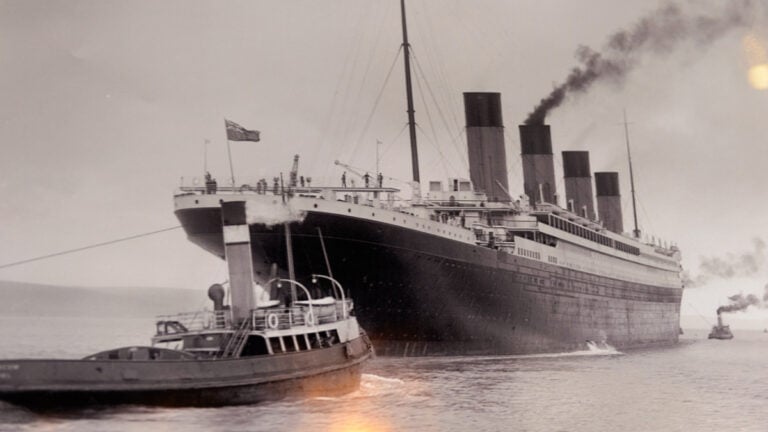
The Titanic Stern: Why It’s More Wrecked Than the Bow
Key Aspects:
The stern was the Titanic’s engineering core, home to the steam engines and three bronze propellers that powered and steered the ship.
It wasn’t all machinery though, with both third-class open decks and lavish first-class lounges sharing the space.
The stern wreck looks far more wrecked than the bow today, as trapped air caused implosions on the way down.
The Titanic’s stern section — or the aft-most part of the ship — held a lot of the ship’s engineering areas, as well as quarters for the lower passenger classes and crew; it was also the very last part of the ship to sink, and it remains dramatically decimated at the bottom of the ocean today.
Let’s take a look at the importance of the Titanic’s stern to the ship’s operations, as well as who would’ve visited this area of the ship, plus what it looks like now.
The Titanic’s Propulsion System
Yes, the Titanic was known for its size and luxury, but it was also known for its speed, thanks to its state-of-the-art (for the time) propulsion system.
The Titanic’s triple-expansion steam engines were considered technological marvels. The steam engine required more than two dozen boilers, which were supplied by more than 150 coal-fired furnaces and the nearly 7,000 tons of coal that the ship carried on board. Each boiler weighed nearly 100 tons, and stood at a height equivalent of a three or four-story building.
These four-cylinder, triple-expansion steam engines were housed within the ship’s Reciprocating Engine Room, in the aft/stern.
The Triple-Blade Titanic Propellers
On a similar note, the Titanic’s propellers — which may seem not all that special to a modern viewer, though you might recognize them from an infamous scene from the 1997 movie, in which a man falls onto a propeller — were actually ground-breaking for the time, and an engineering feat.
The Titanic was outfitted with three propellers in total, and two of these are still attached to the stern wreckage and are visible, while another is suspected to be buried. The two larger propellers measured in at 23.5 feet in diameter, while a smaller, third propeller (the one that’s buried) measured in at 17 feet in diameter.
The propellers are made from bronze, which makes them capable of outlasting much of the deterioration that the rest of the ship has experienced. The propellers could also be independently maneuvered, which helped with steering, particularly in tight spaces. Engineers could turn the ship sharply as needed.
Passenger Areas
While the stern area was more or less functional and devoted to the ship’s propulsion and operational needs, there were still a few passenger areas here. For example, there were some cabins that were available to single women and families. There was also the Titanic poop deck, which was an open-air space for the third-class passengers.
The passenger areas weren’t only limited to these lower-class passengers, though. For example, there was the upscale Café Parisian, with its views of the water, light green walls and European chic vibes.
There was also an aft-end lounge and first-class smoking room. These were places where the wealthier passengers could gather and relax, in environments partially inspired by the Palace of Versailles and lavishly decorated.
If we want to reference the film again, it’s said that the piece of wood that Rose floats on in the ending scenes were modeled after very real panels of decorative wood that would have appeared in these spaces.
The Titanic Stern Wreck: What It Looks Like Today
The Titanic’s stern dramatically broke apart from the rest of the ship and, due to its design, with all of those wide open spaces that housed the ship’s engineering, today it looks almost as if it exploded rather than sank.
In fact, due to air pockets trapped within the stern as it fell below the waves, there were some very literal implosions that caused survivors to think that they were hearing explosions.
Now, this 350-foot section of the ship is part of the very broad Titanic debris field, which covers 15 square miles, just under 400 miles away from the shores of Newfoundland, Canada, in the North Atlantic.
Through numerous, long-term efforts, it was determined that the stern sits about 2,000 feet away from the ship’s bow.
Additionally, due to the way the stern fell apart as it sank (it’s theorized that it literally spun around in quick circles as it did), a mammoth amount of debris was flung off the stern and helped create the existing huge debris field. As such, you’ll find a huge number of items flung out from the stern’s impact site, from the large amount of coal that was originally housed within the stern, to personal items from the passengers.
The stern broke apart from the bow approximately between the ship’s third and fourth funnels, around the aft expansion joint. That dramatic view of the stern rising up so it’s nearly vertical, in the movie? Yep, that’s pretty much accurate.
This is in stark contrast to the bow of the ship. The bow didn’t sink quite so dramatically or quickly, and so not as much damage can be seen. It still looks like, more or less, a ship. However, those implosions and damage are heavily visible on the stern.
It’s estimated that the stern sits at about 12,500 feet below sea level, and that it has sunk as much as 65 feet further into the ocean floor.
If you’d like to learn more about how the tragedy occurred, consider watching the 2025 National Geographic documentary entitled “Titanic: The Digital Resurrection,” which features the most detailed Titanic model ever.
Whether you watch this particular documentary or not, it may be wise to consume as much Titanic content as you can, if you’re interested in this point in history. It’s expected that the Titanic will completely disintegrate in our lifetime, as a type of bacteria, halomonas titanicae, is eating away at the ship.
Frequently Asked Questions About the Titanic Stern
The stern of the Titanic housed the ship’s propulsion systems, but also included a range of passenger areas as well. There were third-class cabins, a poop deck, lounges and dining areas, with some limited to lower-class passengers and others reserved for first-class passengers only.
The Titanic featured three propellers. There were two larger propellers and one smaller propeller, and they could be operated independently, making for easier maneuvers in tight spaces. All of the propellers were made from bronze.
Yes, just as happened in the titular movie, the Titanic’s stern rose out of the water as it sank, to a nearly vertical angle. Then, the stern spun and descended into the ocean in dramatic fashion, imploding as the sea pressure heightened.
The Titanic’s stern is part of the 15-square-mile Titanic debris field in the North Atlantic, about 400 miles away from Newfoundland. The wreckage sits at a depth of about 12,500 feet.
When looking at the wreckage of the Titanic stern vs. bow, there are some specific contrasts — mostly because of the Titanic stern’s layout, greater pockets of air were trapped inside of it when it sank. As such, as the ocean pressure heightened, this caused implosions, which today make the stern appear much more damaged than the bow, which sank slowly.
Part of the ship’s stern, the poop deck was an open-air, outdoor space that was open to third-class passengers. It was one of the last parts of the ship to sink.