
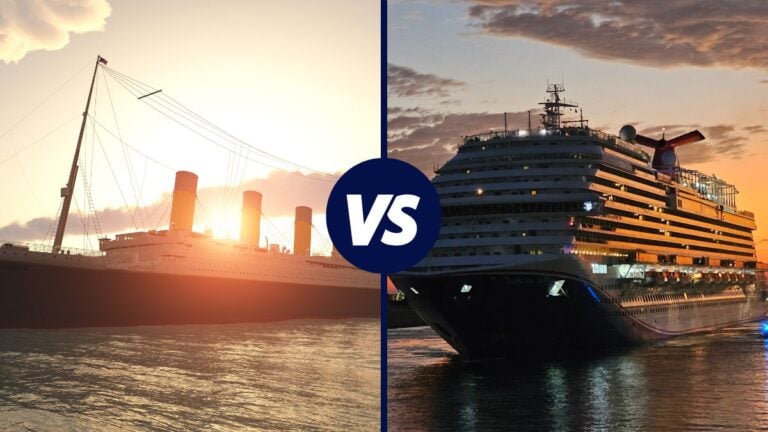
Titanic vs. Modern Cruise Ships: How Do They Compare?
When you think of the most famous cruise ship in history, what ship do you envision? Probably the Titanic, right?
While the Titanic was the largest ship in the world when it first set sail on its ill-fated voyage, though, that’s hardly the case anymore.
Today’s modern ships are more than quintuple the Titanic’s size in gross tonnage, and carry about triple the passengers.
They also offer much different cruise travel experiences. Here’s what to know about the Titanic vs modern cruise ships.
In This Article:
How Big was the Titanic ?Titanic Compared to Cruise ShipsDifferences Between Cabins on the Titanic vs. a Current Cruise ShipSimilarities Between Cabins on the Titanic vs. Modern Cruise ShipsFirst-Class Staterooms on the TitanicSecond-Class Staterooms on the TitanicThird-Class Staterooms on the TitanicWhat was Entertainment Like on the Titanic ?What Was Dining Like on the Titanic?What Were Safety Precautions Like on the Titanic ?How Will the Titanic II Stand Up to the Competition?A Modern Cruise Ship with Titanic-Esque Vibes
How Big was the Titanic?
So exactly how does the ill-fated Titanic, with its unparalleled levels of indulgence, measure up against today’s average cruise ship? Let’s take a look at the quick numbers.
As the most luxurious ship of its time, the Titanic was…
48,328 gross tons
882 feet, 9 inches long
92 feet in width
With 9 passenger decks
And a passenger capacity of 2,435, with a crew of 892
Now, let’s compare that to the current largest class of cruise ships in the world, Royal Caribbean’s Icon class, which includes Star of the Seas and Legend of the Seas. Icon of the Seas measures in at…
248,663 gross tons
1,196 feet long
159 feet in width
With 20 total decks
And a passenger capacity of 5,160 guests at double occupancy, with a crew of 2,350 people
Today, the Titanic would be considered a mid-size ship by passenger capacity, hardly holding a candle to the many massive vessels sailing the high seas in the modern era.
Still, it took ocean travel to new heights when it was built, exceeding all other ships that had come before it and making significant strides in the travel industry.
Titanic Compared to Cruise Ships
Similar size comparisons can be made with other larger ships from all the major cruise lines, including NCL’s brand-new Norwegian Aqua, Carnival Cruise Line’s Carnival Jubilee and MSC Cruises’ MSC World America.
Cruise ShipGross TonnageLengthPassenger CapacityTitanic48,328882 feet, 9 inches2,435Norwegian Aqua156,3001,056 feet3,571Icon of the Seas248,6631,196 feet5,160Carnival Jubilee183,5211,130 feet5,362MSC World America216,6381,092 feet6,762
Compared to today’s state-of-the-art cruise ships, the Titanic just can’t stand up. It even cost a tiny amount to build compared to today’s cruise ships.
Read Also: Symphony of the Seas vs Titanic: A Giant Comparison
In today’s money, the Titanic would cost approximately $400 million to build. Meanwhile, Icon of the Seas cost Royal Caribbean a whopping $2 billion.
Differences Between Cabins on the Titanic vs. a Current Cruise Ship
There are many differences between cabins and their facilities on the Titanic vs. modern cruise ships.
While the Titanic split its diverse range of travelers into first, second and third classes, today’s bigger ships would never do something so possibly offensive. Instead, they offer upgrades upon upgrades, and those who pay for those pricey upgrades get the best treatment.
Think of the VIP cabins and private pools and restaurants that are available to Norwegian Cruise Line’s The Haven passengers, for example; it’s just like their very own first class, just by a different name. (So maybe things aren’t so different after all!)
Additionally, while Titanic passengers may’ve been stuck choosing between three classes, modern cruise ships offer a bevy of stateroom and suite options.
For example, I was recently on Norwegian Aqua and this ship features nine stateroom and suite options within The Haven VIP area alone. Then, there are more than six other types of suites, penthouses and staterooms to choose from throughout the rest of the ship.
Some rooms on Norwegian Aqua can accommodate as many as eight passengers, but those eight passengers are spread across a generous 2,100 square feet, in the largest suite on the ship. (A far cry from the 10 passengers stuffed into the Titanic’s small third-class cabins!)
Another big difference between the Titanic and modern cruise ships? While every single cabin on today’s cruise ships comes with its own private bathroom (even if it is a slightly cramped one), that wasn’t the case on the Titanic.
Instead, many first-class passengers, despite their luxury, were forced to share communal restrooms.
Additionally, due to a lack of fresh water, baths were taken in sea water and, for similar reasons, there was no laundry service, even for the sheets (though first-class passengers had their linens changed daily).
One thing, though, that the Titanic offered that today’s cruise ships do not? Cabins that included separate servants’ quarters. So posh!
Similarities Between Cabins on the Titanic vs. Modern Cruise Ships
Still, there are some similarities between cabins on the Titanic and cabins on today’s passenger ships.
Much like many of today’s best cruise ships aim to model their cabins after high-end hotels, with modern and luxurious furnishings, right down to the interior cabins (just take a look at some of Royal Caribbean’s newest ships), so did the Titanic.
In fact, the Titanic’s designers looked to the Ritz Hotel in London as inspiration for their decor.
As such, the Titanic’s opulent interiors were decked out with elegant European-style decor, with sweeping staircases (yes, including the one from the movie), ornate woodwork and luxurious furnishings.
Also, just like today’s cruise ships, the Titanic offered connecting cabins for groups and families.
First-Class Staterooms on the Titanic
Your onboard experience on the Titanic would differ heavily depending on your class.
In total, the Titanic featured around 350 first class cabins, of which a small portion could be used as second-class staterooms if needed.
These most luxurious and most spacious staterooms were decorated in nearly a dozen different styles, from Georgian to Jacobean to Italian Renaissance, with a fine attention to unparalleled luxury and detail in recreating every historic aspect of the various decor styles.
Depending on where a passenger’s stateroom was located on the ship, that luxury extended out into the halls, via cut-glass ceiling fixtures, gilt details, lavish amenities and more. Everything was thought of to provide guests with the utmost in relaxation and high taste.
That said, for all their comfort, you’re not going to find common modern features in these first-class cabins from the early 1900s. Forget the hot tub or private balconies.
Second-Class Staterooms on the Titanic
The ship’s second-class accommodations boasted room for over 500 second-class passengers — perhaps that’s because the Titanic crammed its second-class passengers into every nook and cranny it could?
Second-class passengers slept in bunk beds, in cabins that came with either two or four bunk beds apiece.
Read Also: What to Expect in a Cruise Ship Porthole Cabin
Despite the cramped quarters, those second class rooms still had their linens changed daily, and there was a sink in each cabin, even if the restrooms were communal.
Third-Class Staterooms on the Titanic
But no one had it as bad as those in third class (though, compared to other trans-Atlantic liners at the time, the situation could have been worse). The Titanic’s third-class passengers numbered about a thousand individuals.
Cabins were outfitted for 10 passengers each and were located near the engines. And for all of those passengers, there were only two bathrooms.
Third-class passengers were fed a basic diet, nothing fancy, but the food was free and there were leisure spaces for the guests to socialize.
What was Entertainment Like on the Titanic?
Today’s modern cruise ships are basically floating resorts, playgrounds filled with tons to do and see.
For example, Icon of the Seas is particularly notable for its diverse array of entertainment options and amenities, with its seven pools, six waterslides, more than 40 restaurants and bars, AquaTheater, casino, surfing simulators, laser tag, miniature golf, rock climbing walls, theater with Broadway-style shows, comedy clubs, fitness centers and more.
While you wouldn’t find any casinos, surfing simulators or rock-climbing walls on the Titanic, you would find lots of entertainment venues suitable to the day.
There were wellness facilities that featured the workout gear that you would expect at the time, as well as a few pieces that would be recognizable to cruisers in gyms today (like stationary bikes, though you likely wouldn’t recognize the electric horses and camels).
Instead of traditional spa services and spa treatments, there was a Turkish bath, steam rooms, saunas and massages room for guests’ well-being needs. There was only one pool, compared to the many, many water attractions you’ll find on today’s cruise ships.
Worth Reading: The Grandeur of the Titanic Interior Design
Other entertainment-geared spaces included a squash court, smoking room, lounge, reading and writing room and promenade.
You would not, however, unlike on today’s cruise ships, find huge theaters or live music performances by cover bands. Despite this, there was enough to keep high-class passengers’ boredom at bay.
What Was Dining Like on the Titanic?
For the longest time, cruise industry food didn’t receive a great reputation, but thanks to a few modern cruise lines’ efforts and some world-class chefs, that’s all changed.
Certain cruise lines have gained a great reputation for their culinary offerings and delicious meals. Royal Caribbean’s first Oasis class ship, Oasis of the Seas, gives guests more than 20 spots to dine and drink, ranging from casual eateries to gourmet restaurants to specialty cuisine venues.
Now, cruise lines offer not just extravagant dining experiences, but also cooking classes and themed parties in their restaurants, and they can cater to your dietary restrictions with ease.
The variety of dining options were more limited aboard the Titanic, though. The ship boasted four restaurants: A la Carte Restaurant, the Dining Saloon, the Verandah Cafe and the Cafe Parisien.
A la Carte Restaurant was open to first-class passengers only and was one of the earliest examples of for-a-fee dining on a cruise ship. An alternative to the main dining room, it was smaller and served the most fashionable of French decor.
Passengers could show up and dine whenever they liked, no set dining reservations required (again, much like for-a-fee dining on today’s cruise ships).
A passenger would later describe the food as “superb” and including “caviar, lobster, quail from Egypt, plovers’ eggs, and hothouse grapes and fresh peaches.”
The grand dining saloons, on the other hand, were basically the ship’s equivalent of today’s main dining room. Passengers were assigned seating for the length of the voyage and had to show up at specific times in order to eat.
Both the Verandah Cafe and the Cafe Parisian were located off the promenade, and offered a more intimate, casual dining experience than could be found with the other two selections. Sadly, 24-hour room service was not an option.
What Were Safety Precautions Like on the Titanic?
Given the tragic sinking of the Titanic, this question doesn’t really need to be asked, as this ship wasn’t exactly known for its stringent safety regulations or rigorous safety drills.
However, for comparison’s sake, let’s look at how the Titanic stacks up against modern cruise ships in terms of safety features.
The Titanic was only equipped with 20 life rafts, or enough for 1,178 people. The ship was also outfitted with approximately 3,500 life jackets and 48 life rings.
Read Also: How Cold Was the Water When the Titanic Sank?
However, those were of little use for a great number of passengers, given the temperature of the water and the quick onset of hypothermia.
In comparison, the gigantic cruise ship Icon of the Seas is outfitted with 17 lifeboats that can fit 450 passengers each, for a total of 7,650 passengers in lifeboats.
Additionally, the ship features a Marine Evacuation System, which basically deploys more inflatable rafts during an emergency.
These inflatable rafts would be used by crew members in the event of an emergency, with lifeboats reserved for passengers, as the rafts can be difficult to navigate.
How Will the Titanic II Stand Up to the Competition?
In 2012, Blue Star Line, based out of Australia, launched a Titanic II project, hoping to replicate the fateful ship.
Still, though, even with all the modern advancements of cruising, the Titanic II won’t quite be able to stand up to today’s biggest and best cruise ships — that is, if it’s even completed at all.
The ship was initially planned to be finished in 2016, but things were delayed, then Covid-19 happened, causing further delays.
As of 2024, though, the project was underway again, with newly unveiled information revealing that the ship would provide as much of an authentic experience as possible — right down to the first, second and third classes.
Passengers will be encouraged to dress for the time period, and the dining will be period appropriate as well (so you might want to think twice about booking that third-class experience).
The planned ship is expected to be 833 feet long, with nine decks and 835 cabins capable of holding just over 2,300 passengers. The current hope is for it to set sail in 2027.
A Modern Cruise Ship with Titanic-Esque Vibes
But what if you want to take a cruise on a modern, contemporary cruise ship, but you don’t really like the sound of an exact Titanic replica?
Consider a voyage on Cunard’s Queen Mary 2. An ocean liner, just like the Titanic, designed for transatlantic journeys, the ship similarly set a new standard when it debuted as the longest, tallest, widest, priciest, biggest passenger liner thus built.
The ship is definitely not the title holder of these records anymore, but is still the largest ocean liner ever built — a key distinction, as ocean liners are built with rougher ocean crossings in mind, compared to standard cruise ships.
Transatlantic voyages on ocean liners also offer fewer shore excursions in exotic destinations (or even no shore excursions!) than cruise ships traveling around the Caribbean or Mediterranean, with passengers spending their time enjoying onboard activities.
Worth Reading: How Much Was a Ticket on the Titanic?
Of course, the Queen Mary 2 is still quite a bit larger than the Titanic, at 149,215 GT, but the ship is somewhat similar in length and passenger capacity, at 1,132 feet long and holding 2,695 people.
The ship also offers an elegant, somewhat old-fashioned vibe, with fewer flashy amenities and less overall features as compared to a resort-style cruise ship like the ones discussed above.
The Queen Mary 2 even follows a similar route to the Titanic, traveling between Southampton and New York City, making for a memorable vacation experience.